I’ve been making cakes for around 15 years, and I haven’t always thought about wedding cake inspiration or the design process the way I do now.
I’ve made the white cakes. I’ve worked from inspiration pictures of other wedding cakes. I’ve created designs that reflected what couples were asking for at the time, and I’ve made cakes that became popular and then found myself making versions of them again and again.
But alongside that, I was always trying to push things a little further.
I’d suggest colour.
A less traditional shape.
A different way of displaying the cake.
Something unexpected in the design.
Quite often the response was essentially:
“We love that idea… but can we have the other one?”
And the other one was usually the safer option.
So I made it.
That’s what my business did at the time.
But after 15 years of working in weddings, I’ve realised I’m no longer particularly interested in making the safest option.
Because I’ve spent years noticing something that I can’t really unsee.
Sometimes the cake doesn’t belong to the wedding
I see beautiful weddings where everything seems to have been carefully considered.
The venue has character.
The flowers have movement and colour.
The stationery has personality.
The outfits have been chosen because they feel like the people wearing them.
The tables have been styled.
The room has an atmosphere.
And then there’s the cake.
Perfectly lovely. Beautifully made.
But it could have come from almost any wedding.
And increasingly I find myself looking at it and thinking:
Why?
Why, after making all those wonderfully personal decisions, does the cake so often become the place where we suddenly play it safe?
That’s probably the biggest change in the way I think about wedding cakes now.
I don’t want to design a beautiful cake in isolation.
I want to design something that belongs to the wedding around it.
Why wedding cake inspiration doesn’t have to begin with cake
These days, one of the last places I want to start when designing a wedding cake is another wedding cake.
Which admittedly sounds slightly ridiculous coming from a wedding cake designer.
But if the first thing we do is look at other cakes, we’re already working within the boundaries of what somebody else has created.
I’d rather look at your wedding.
And sometimes, I’d rather look completely outside weddings altogether.
Fashion.
Interiors.
Architecture.
Art.
Textiles.
Jewellery.
Flowers.
Landscapes.
Nature.
Anything can become inspiration once you stop asking:
“How could I put this on a cake?”
and start asking:
“What is it about this that I love?”
A rotting tree can be more useful than Pinterest
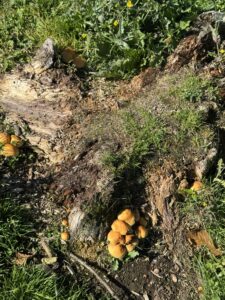
I was walking recently when I spotted an old fallen tree.
It was broken and weathered, with rough bark, moss, grasses and clusters of orange fungi growing through it.
So naturally, I stopped and photographed it. 😂
Because my brain had already started pulling it apart.
There was texture everywhere.
Rough wood against soft moss.
Deep browns interrupted by vivid orange and green.
Tiny fungi growing beside huge pieces of timber.
Irregular shapes.
Layers.
Nothing symmetrical or perfectly arranged, yet somehow everything belonged together.
And immediately I started thinking about edible design.
Not because I want to make a cake that looks like a fallen tree.
And definitely not because I’m about to enter my rustic era.
But because that’s what woodland actually looks like.
If somebody tells me they want a woodland-inspired wedding, there’s an enormous visual world to explore before we reach the usual shorthand of wood slices, greenery and something described as “rustic”.
The interesting bit is finding out what woodland means to them.
Dark and atmospheric?
Wild and overgrown?
Soft and romantic?
Mossy and ancient?
Autumnal and richly coloured?
Almost otherworldly?
Those could produce completely different cakes from exactly the same starting point.
Inspiration isn’t the same as copying
This is probably one of the biggest things I’ve learned about design.
If you show me an embroidered dress, I don’t necessarily want to reproduce the embroidery in sugar.
If you show me an incredible room, I don’t want to make a miniature edible version of the interior.
If you show me a floral installation, I don’t automatically want to cover your cake in flowers.
I might be interested in something completely different.
The movement.
The proportions.
The contrast.
The way one colour appears against another.
The balance between empty space and detail.
The combination of something highly structured with something wild and organic.
The original inspiration might not be recognisable in the finished cake at all.
But its design language can still be there.
That’s the difference between taking inspiration from something and simply reproducing it.
I want to understand why you like what you like
This has changed the questions I ask couples too.
I’m not only interested in what colour your bridesmaids are wearing or whether you’ve saved a picture of a cake you like.
I want to understand the whole visual world of the wedding.
What does your venue feel like?
What have you chosen for your flowers?
What are you wearing?
What does your stationery look like?
Are there interesting architectural features in the room?
Have you chosen rich, dramatic colours or soft tonal ones?
Is everything polished and structured, or loose and organic?
And if you show me an inspiration image, the important question isn’t necessarily:
“Do you want this?”
It’s:
“What is it about this that caught your attention?”
Because that’s where the useful information usually is.
The cake has to live somewhere
This is another thing I’ve become increasingly obsessed with.
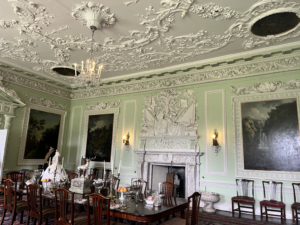
A wedding cake doesn’t exist against the clean background of an Instagram photograph.
It exists in a room.
And that room changes everything.
A cake might be sitting beneath an enormous historic ceiling, against dark panelling, beside huge windows, inside a marquee, surrounded by flowers or underneath dramatic lighting.
So the question isn’t simply:
“What should the cake look like?”
It’s also:
“What does the cake need to do in this space?”
Sometimes it needs height.
Sometimes it needs strong colour.
Sometimes it needs an unusual silhouette.
Sometimes it needs space around it.
Sometimes the cake itself doesn’t need to become bigger at all. Changing its position, proportions or presentation can completely change its impact.
I’ve become increasingly convinced that:
Your cake is part of the room, not an object placed into it.
And once you start thinking that way, the traditional little cake table shoved into whatever corner happens to be available becomes much harder to accept. 😂
Not everything needs to go on the cake
Ironically, looking at more sources of inspiration doesn’t mean putting more things onto the finished design.
Often it means the opposite.
Good design isn’t about cramming every meaningful detail of your wedding onto three tiers.
Your flowers don’t necessarily need recreating.
Your stationery doesn’t need copying.
Your dress doesn’t need transferring onto icing.
Your venue doesn’t need turning into an edible building.
Somewhere amongst all those choices there will usually be a thread.
Maybe it’s movement.
Maybe it’s colour.
Maybe it’s architecture.
Maybe it’s a particular shape, texture or feeling.
Finding that thread gives me something far more useful than a list of things to reproduce.
Then comes restraint.
What deserves to be included?
What can disappear?
What is the one idea that absolutely needs to survive?
That’s when a collection of inspiration starts becoming a design direction.
And that’s where the Blueprint came from
This way of thinking eventually became the foundation for The Bespoke Wedding Cake Blueprint.
Not because I wanted couples to design their own cakes.
Quite the opposite.
I created it because I realised that couples are surrounded by inspiration but aren’t necessarily given a way to understand what they’re looking at.
You can have 200 Pinterest saves and still have absolutely no idea what you actually want.
Or you can know that you love your venue, your flowers, an outfit, an interior you’ve seen or a photograph that has absolutely nothing to do with weddings, without knowing how any of that could possibly be useful to a cake designer.
The Blueprint helps pull those things apart.
It looks at atmosphere, inspiration, colour, the room, visual impact, texture and practical requirements and turns those choices into a clear creative brief.
It doesn’t tell you what your cake should look like.
And it doesn’t design the cake for your cake designer.
It gives them the story the cake needs to tell.
Because that’s where their expertise should begin.
Maybe this was always where I was heading
Looking back, I don’t think I’ve suddenly become a completely different cake designer.
The clues were probably there all along.
Even when I was making the more traditional cakes people were asking for, I was usually trying to push the design somewhere else. More colour. A different shape. An unexpected detail. A more interesting way of displaying it.
Sometimes couples went with me.
Sometimes they loved the idea and then chose the safer version.
And for years, I was happy to make that version too.
What’s changed isn’t that I’ve suddenly discovered colour, sculpture or unconventional design.
I’ve stopped pulling myself back from them.
After 15 years, I know which part of this work makes my brain light up. It’s the part where I’m given room to explore an idea, question the obvious answer and see what else a wedding cake could be.
So perhaps this isn’t me becoming more stubborn.
Maybe it’s the cake designer who was there all along finally being allowed out. 😂
I don’t think it has to be a separate object that happens to be there because weddings traditionally have cakes.
It can respond to the room.
It can take cues from fashion.
It can borrow movement from flowers.
It can take proportions from architecture.
It can be influenced by art, interiors, landscapes, materials and nature.
It can feel completely at home in the wedding without looking like anything else in it.
And sometimes the starting point might genuinely be a rotting tree I photographed while walking the dog.
Your wedding cake inspiration doesn’t have to be another wedding cake.
In fact, I think that’s where things start getting interesting.