
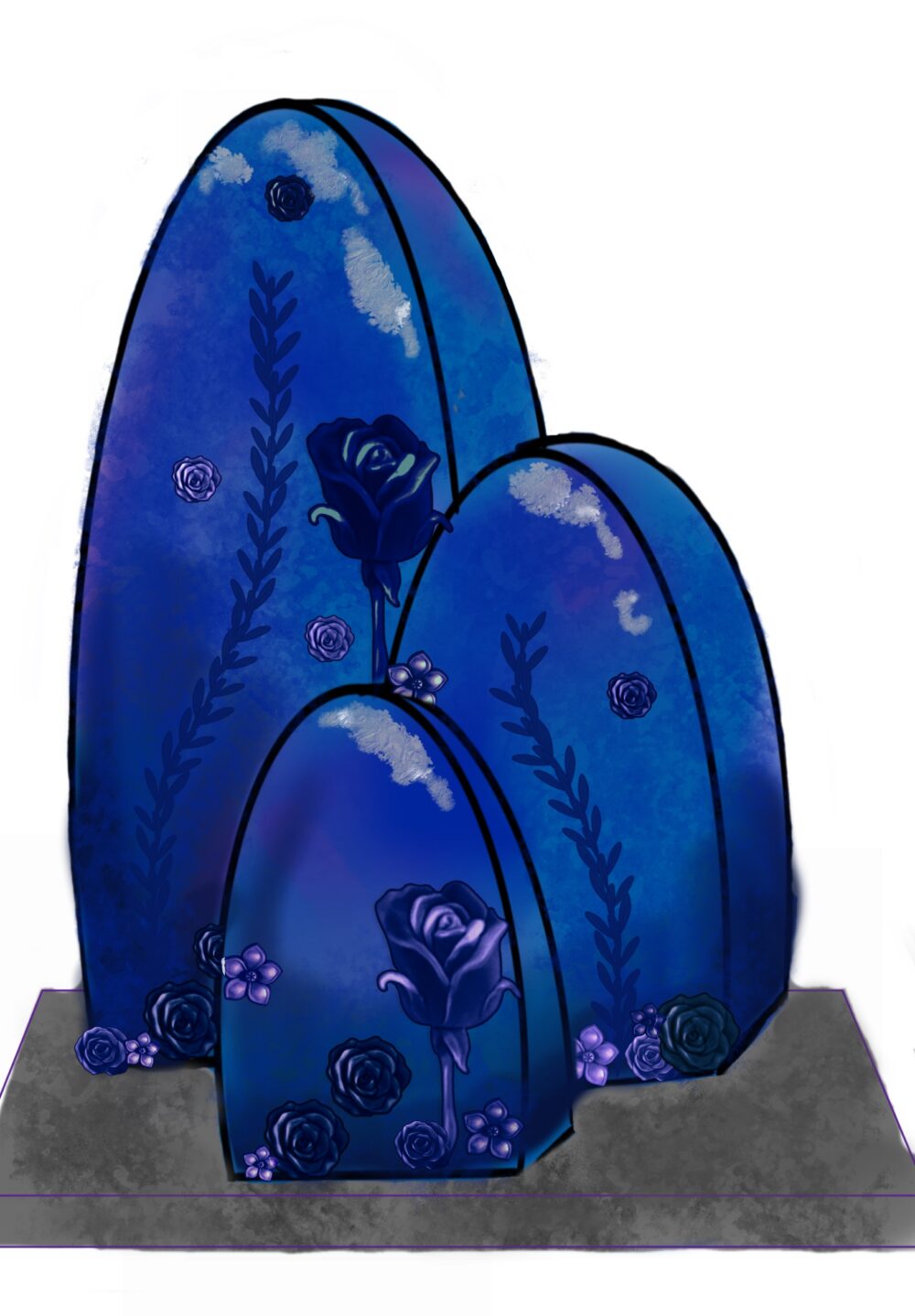
At what point did looking at other wedding cakes become the starting point for original wedding cake design?
It’s something I’ve been thinking about for quite a while.
Scroll through wedding cake inspiration and you’ll find an extraordinary amount of talent. Beautiful finishes, intricate sugar flowers, flawless craftsmanship and techniques that take years to master.
But you’ll also notice something else.
The same designs appearing repeatedly.
Different colours. Different flowers. Perhaps a slightly different arrangement.
And quite often, they’re described as something new, unique or different.
But are they really?
Because there’s a difference between making something beautifully and actually designing something.
And I think it’s a distinction we don’t talk about enough.
I’ve Been Part of the Cycle
Before anyone thinks I’m pointing fingers, I’ll happily admit that I’ve spent years working this way myself.
Couples would arrive with photographs of wedding cakes they loved.
Sometimes it was one cake. Sometimes it was four.
The shape from one, the flowers from another, a texture from somewhere else and perhaps a different colour palette.
My job was to bring those elements together and create the finished cake.
And that’s exactly what I did.
I would often suggest alternatives, introduce different ideas or offer a more creative direction.
Some couples loved that and gave me the freedom to explore.
Others preferred to stay close to the original photographs.
And that’s entirely understandable.
They’d found something they loved. They weren’t necessarily looking for a completely new design.
But it raises a question.
When the visual decisions have already been made using somebody else’s work, how much designing is actually left to do?
There’s still skill involved.
There’s craftsmanship, technical planning, proportion and the ability to execute everything beautifully.
But the creative starting point already exists.
You’re not developing an idea from scratch.
You’re rearranging someone else’s.
The Never-Ending Cycle
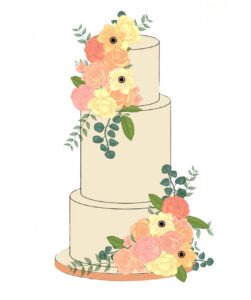
For me, the frustration became particularly obvious with semi-naked wedding cakes.
Tiered cakes with flowers.
Again and again.
Different flowers, perhaps. Different arrangements. Occasionally a slightly different number of tiers.
But essentially the same thing.
There’s skill involved in producing a well-made semi-naked cake, of course.
But when the design has already been established and the brief is simply to reproduce that familiar style, there isn’t much creative design work left to do.
And I was finding myself increasingly frustrated.
Not with the couples.
With the cycle.
I was advertising cakes that I no longer particularly wanted to make, which naturally attracted more enquiries for those exact cakes.
So I made more of them.
Which meant I had more photographs of them.
Which meant I continued advertising them.
And round we went.
Meanwhile, I’d always loved working with colour, unusual shapes, sculptural elements and unexpected combinations.
That wasn’t something I suddenly discovered.
I have a background in art and design. Creative thinking has always been part of how I work.
But the commissions I was repeatedly attracting weren’t giving that side of me much room.
Eventually, I decided to stop advertising the work I didn’t want to keep making.
Not because I’d become a different designer.
Because I wanted to spend more of my time actually designing.
Craftsmanship Isn’t the Same as Design
This is where I think the conversation becomes interesting.
Someone can be an exceptional cake maker without necessarily being an original designer.
Their craftsmanship might be impeccable.
Their sugar flowers might be astonishingly realistic. Their finishes flawless. Their technical knowledge extraordinary.
And none of that should be dismissed.
But craftsmanship and design are different disciplines.
Craftsmanship is about the skill required to make something.
Design is about deciding what that something should be in the first place.
It’s understanding colour theory, proportion, contrast, balance, negative space and visual flow.
It’s thinking about how shapes interact.
How the eye moves through a piece.
Where a colour should sit and why.
Whether something needs more detail or whether adding another element would weaken the entire composition.
And sometimes, perhaps most importantly, it’s knowing when to stop.
Not every empty space needs filling. Not every tier needs decorating. Not every idea needs including.
Knowing what to leave out is as much a part of design as knowing what to put in.
You can be technically brilliant at reproducing an existing cake.
But reproducing something beautifully doesn’t automatically make it an original design.
And I don’t think recognising that takes anything away from the craftsmanship involved.
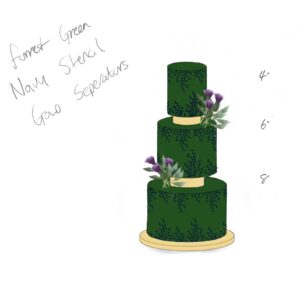
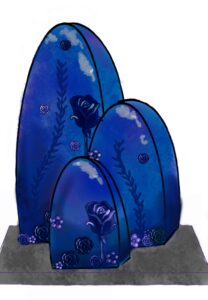
For me, designing often begins with a sketch.
Sometimes it’s a response to a couple’s brief. Sometimes it’s an idea I’ve been carrying around for months. Other times, it’s simply an opportunity to explore a shape, a colour combination or a technique without knowing whether it will ever become a finished cake.
Not every design gets made.
Some are developed further, some are put aside, and some remain exactly where they began as drawings.
But that doesn’t make the design work any less valuable.
The exploration, the decisions, the things I change or remove along the way, that’s all part of designing.
And it’s a part of cake making that rarely gets seen.
Four Cakes Don’t Necessarily Make One Original Design
We’ve all seen the inspiration boards.
The shape of this cake.
The flowers from that one.
The texture from another.
And the colours from a fourth.
Combine them, and apparently we’ve created something entirely new.
But have we?
Or have we simply rearranged existing designs?
There’s nothing inherently wrong with adaptation. Sometimes that’s exactly what a client wants.
And combining those elements successfully can still require good judgement.
But I think we need to be more honest about the difference between adapting a design and creating one.
Made specifically for someone doesn’t automatically mean designed from scratch.
A cake can be bespoke in its size, flavours, colours and execution while still being heavily based on somebody else’s visual ideas.
That’s not necessarily a criticism.
It’s simply a distinction.
And one I think matters when we talk about originality.
And Then There Are the Trends
Wedding cakes have trends just like fashion, interiors and everything else.
A particular shape becomes popular.
A certain style of flower arrangement appears.
A new texture starts circulating.
And suddenly, variations of the same design are everywhere.
There’s nothing wrong with enjoying a trend.
But I do wonder how often we’re choosing those elements because they’re genuinely right for the design, rather than simply because we’ve seen them so many times.
And that leads to something else that really bothers me.
Sometimes a wedding cake looks as though it belongs at an entirely different wedding.
It might be absolutely beautiful.
The craftsmanship might be faultless.
But put it in the room where it’s actually being displayed, and it feels completely disconnected from everything around it.
Because a wedding cake doesn’t exist in isolation.
It exists within a space.
A space with architecture, lighting, colours, proportions, textures and atmosphere.
The design should have some relationship with those surroundings.
That doesn’t mean matching the flowers to the centrepieces or choosing a colour because it appears on the invitations.
Sometimes contrast is exactly what makes a design work.
But it should be considered contrast.
A deliberate choice.
Not simply a fashionable cake placed in a room where it has no visual connection to anything.
A cake can be beautiful on its own and still be wrong for the space.
And to me, considering that relationship is part of designing.
What Happens When You Stop Looking at Other Cakes?
For me, this has been the most exciting part.
When a couple comes to me with a brief, a mood board, a colour palette or simply a feeling they want to create, I have somewhere completely different to begin.
I’m not trying to work out how closely I can reproduce an existing cake.
I’m thinking about what the brief could become.
What shapes might work.
How the colours might interact.
Where I can introduce movement, contrast or something unexpected.
And how the finished piece will sit within the wedding itself.
Take my Queer Speakeasy cake.
The inspiration came from a mood board, not another wedding cake.
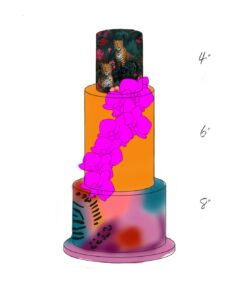
I could explore its atmosphere, colours and visual elements, then translate those ideas into something a little weird, a little wonderful and entirely its own thing.
It still resembled a wedding cake.
But it didn’t need to resemble somebody else’s wedding cake.
That’s where the magic happens for me.
I have a brain full of ideas, and inspiration can come from almost anywhere.
Fashion. Textiles. Architecture. Art. An unusual colour combination. A shape. A particular atmosphere.
Sometimes it’s something I’ve seen that stays in my head for years before finding its way into a design.
The exciting part is working out how those influences can become something new.
Not deciding which existing cake to borrow them from.
It’s also why I’ve never wanted my wedding cake gallery to become a catalogue of designs for couples to choose from. Each cake should begin with its own story, rather than somebody else’s finished design.
Does Every Wedding Cake Need an Original Design?
No.
And I think that’s important to say.
Not every couple wants something unusual or unexpected.
Some love traditional designs.
Some have had a particular wedding cake saved on Pinterest for years and know exactly what they want.
There’s absolutely nothing wrong with that.
Equally, not every cake maker wants to specialise in original design.
There’s room for exceptional craftsmanship, traditional cake making, adaptations of existing styles and entirely new creative work.
They all have their place.
What I question is whether we’ve started treating all of those things as though they’re the same.
Because they aren’t.
And I think the distinction matters, particularly in an industry where words like unique, creative and bespoke are used so frequently that they can begin to lose their meaning.
Are We Designing, or Are We Just Rearranging?
No creative person works in a vacuum.
Everything we see, experience and learn influences the way we think.
I’m certainly not suggesting that originality means producing ideas completely untouched by anything that came before.
But there’s a difference between drawing inspiration from the world around us and continually looking at other people’s finished work for the answers.
I know that because I’ve worked both ways.
For years, I found myself adapting existing designs far more often than I wanted to.
And although I was proud of the craftsmanship involved, I increasingly missed the part of my work that I loved most.
The thinking.
The experimenting.
The freedom to explore an idea without already knowing what the finished cake was supposed to look like.
I haven’t changed who I am as a designer.
I’ve simply stopped putting the work I no longer want to make at the centre of my business.
And in doing so, I’ve given myself more room to create the work I’ve always loved.
Because after fifteen years of making cakes, one thing has become very clear to me.
I don’t want to spend the next fifteen rearranging the same designs.
I want to keep exploring what a wedding cake could be.
And sometimes, the best place to start is by not looking at another wedding cake at all.