
After 15 years working in wedding cake design, I’ve seen some extraordinary wedding styling.
Bold floral installations. Unexpected colour combinations. Beautifully considered tablescapes. Fabric draping that completely transforms a space. Couples choosing venues, outfits and details that feel entirely their own.
And then I see the wedding cake.
Three white tiers. A few flowers. Perhaps a little texture.
A perfectly lovely cake, in isolation.
But sometimes I find myself looking at it and wondering whether it’s turned up at the wrong wedding.
How can a wedding be so individual in every other detail, yet the cake still look like something chosen from a completely different celebration?
It’s a question I’ve been thinking about more and more.
When Did Certain Venues Start Coming With Certain Cakes?
Take a rustic wedding venue.
Somewhere with exposed beams, stone walls, beautiful countryside and perhaps a slightly relaxed atmosphere.
Why does that so often lead to a semi-naked wedding cake?
There’s nothing inherently rustic about exposed sponge and buttercream. Somewhere along the way, it simply became the expected pairing.
Rustic venue? Semi-naked cake.
Elegant country house? White tiers and sugar flowers.
Modern venue? Perhaps something a little more structured, but still recognisably a traditional wedding cake.
These aren’t rules. They’re associations we’ve developed through years of seeing similar images.
And once we see something often enough, it starts to feel like the natural choice.
But what happens when we stop making those associations?
What if the rustic venue has incredible architecture, dramatic lighting or a couple whose personal style is anything but rustic?
What if the country house wedding is filled with vibrant flowers, contemporary fashion and unexpected details?
Would we still arrive at the same cake?
I’m not convinced we would.
Are We Approaching Wedding Cake Design Backwards?
When couples begin looking for a wedding cake, what do they usually do?
They look at wedding cakes.
Pinterest, Instagram, wedding websites, portfolios.
And I understand why. Wedding cake design can be overwhelming. There are so many styles, shapes, finishes, flowers and decorative techniques that it’s difficult to know where to begin.
So couples start collecting things they like.
The shape of one cake. The flowers from another. The texture of a third. Perhaps the colours from a fourth.
Eventually, those elements are combined into something new.
But I’ve started questioning that entire process.
Why are we beginning with someone else’s cake?
That original cake was designed for another couple, another venue and another wedding.
Changing its colours or replacing its flowers doesn’t necessarily make it yours.
It makes it a variation of something that already existed.
And that’s a very different thing from having a cake designed specifically for you.
Are We Designing, or Are We Just Rearranging?
I think wedding cake designers need to take some responsibility for this, too.
We’re constantly surrounded by images of other wedding cakes.
They’re in our portfolios, on Pinterest, across Instagram and in the inspiration photographs couples send us.
And when a couple arrives with a collection of cake images, we naturally start working from those references.
The shape of one. The texture of another. Different flowers. A different colour palette.
We combine those elements, make adjustments and produce something that feels new.
But here’s the question I think we should be asking ourselves.
Are we actually designing something new, or are we simply rearranging things that have already been designed?
There’s a difference.
I’m not suggesting that every cake inspired by another cake is a copy. Inspiration and interpretation are fundamental parts of creative work.
But when our starting point is always another wedding cake, we’re already limiting the possibilities.
We’re working within a visual language that someone else established.
And perhaps that’s why we see so many variations of the same designs.
The same tier arrangements. The same floral placements. The same finishes, repeated in slightly different colours.
We’ve become very good at creating variations.
But what might we create if we stopped looking at cakes altogether?
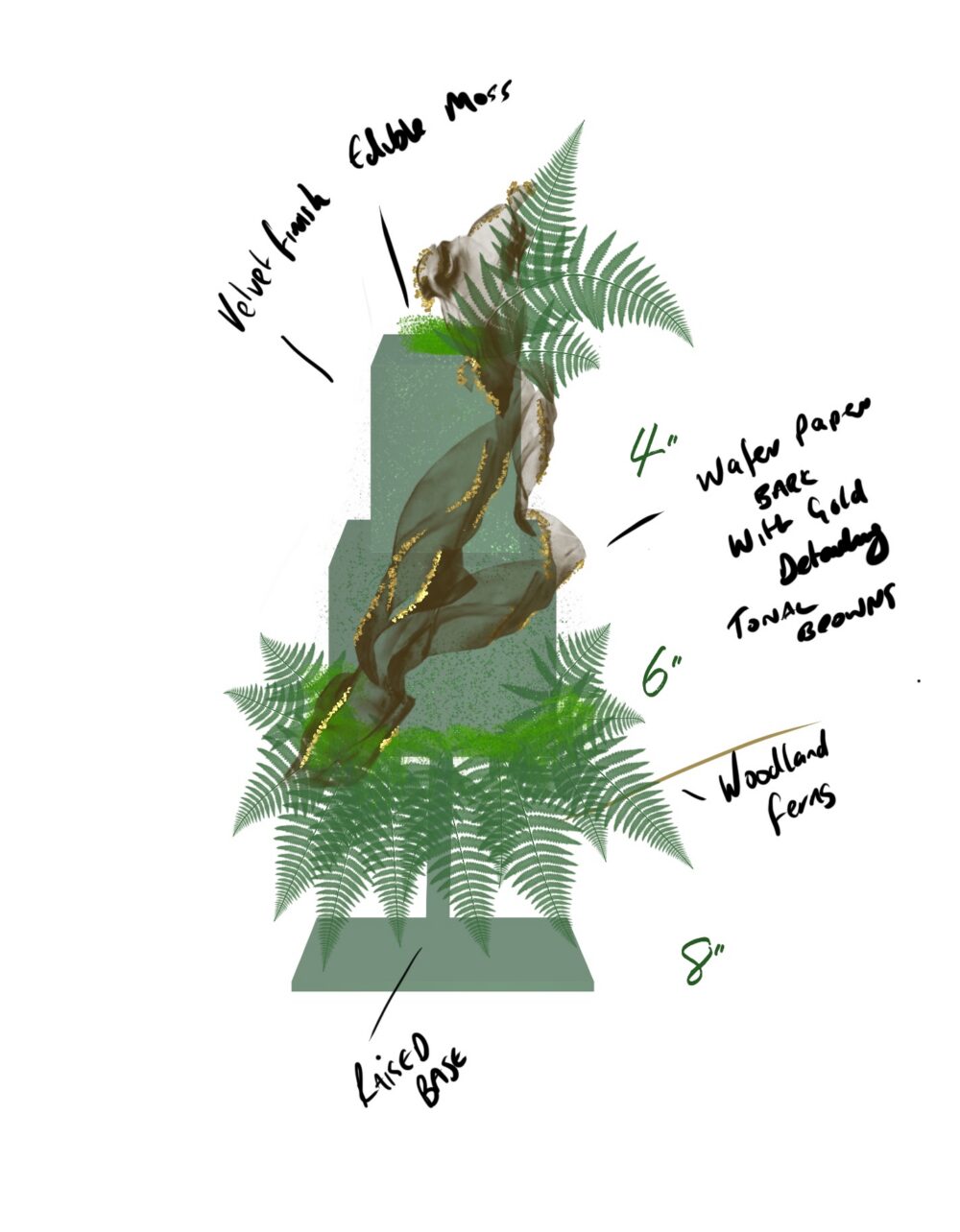
What if a couple came to us with photographs of their venue, the architecture, the fabrics, the flowers, their outfits and the atmosphere they wanted to create?
What if they brought us an image of a sculpture, a piece of furniture, a fashion collection or something completely unexpected?
What if we asked questions about the people we’re designing for before asking what kind of cake they like?
Would we still arrive at a three-tier white cake with flowers?
Would we still automatically suggest a semi-naked cake because the wedding is taking place in a barn?
I know I wouldn’t.
And that’s not because those designs are inherently wrong.
It’s because I wouldn’t have arrived at them by following the usual visual shortcuts.
I’d be responding to the actual wedding.
Its architecture. Its atmosphere. Its colours, textures and proportions. The personalities of the people getting married.
That’s where I believe genuinely individual design begins.
Not with the question, “Which wedding cakes do you like?”
But with something much more interesting.
“Tell me about everything else.”

If we weren’t shown any cake photographs at all, would we have arrived at that design?
Imagine being given everything else instead.
The venue. The architecture. The flowers. The outfits. The fabrics. The stationery. The atmosphere the couple wants to create.
Perhaps a favourite piece of art, an unusual object or something that has absolutely nothing to do with weddings.
Imagine starting there.
What shapes would emerge?
What materials, textures and proportions would feel right?
Would the design be tall and architectural? Soft and flowing? Sculptural? Playful? Dramatic?
Would it even resemble the wedding cakes we’re accustomed to seeing?
For me, the answer is often no.
And that’s precisely what makes the process exciting.
Wedding Cake Design Doesn’t Exist in Isolation
One of the things I find fascinating about wedding design is how much thought goes into creating a cohesive atmosphere.
Couples consider how their flowers work with their venue, how the table styling complements their colours and how the lighting changes the feeling of a room.
Every element contributes to the overall experience.
Yet the wedding cake is sometimes treated as an entirely separate decision.
Choose a cake style. Choose a flavour. Add some flowers.
Done.
But your cake is going to stand in that room.
It’s going to be photographed against the backdrop you’ve spent months creating.
And apart from the couple themselves, it’s often one of the most photographed individual elements of the wedding.
So why shouldn’t it be considered part of the wider design?
I’m not suggesting everything needs to match.
In fact, sometimes the most interesting design decision is to introduce contrast.
But there’s a difference between something deliberately contrasting with its surroundings and something that simply has no relationship to them.
A wedding cake can belong to a space without disappearing into it.
It can respond to the architecture, echo a movement found in the florals or introduce a completely unexpected shape that brings the whole room together.
It can be part of the visual story rather than an object placed into it at the end.
This Isn’t an Argument Against Traditional Cakes
I should make something clear.
If you’re having a traditional wedding and you love traditional wedding cakes, have one.
If you’ve always dreamed of a white tiered cake with beautiful sugar flowers, that’s exactly what you should choose.
I’m a huge believer in doing what feels right for you.
What I question is choosing something simply because it’s what a wedding cake is supposed to look like.
Tradition can be a wonderful thing when it’s a conscious choice.
It’s less interesting when it becomes the default because nobody has stopped to ask whether there’s another possibility.
And yes, budget plays a part.
Not every couple has the budget for an elaborate sculptural commission. Different designs involve different levels of labour, materials and technical complexity.
But the principle of thoughtful design isn’t reserved for the biggest budgets.
Even when there are practical limitations, we can still question the assumptions we’re starting with.
A cake doesn’t have to be enormous or extravagantly decorated to feel considered.
What Happens When We Stop Looking at Cakes?
This is the question I keep coming back to.
What happens when a couple approaches a cake designer without a folder full of wedding cake photographs?
When instead of saying, “I like this cake, but could we change the flowers?” they say:
This is our venue.
These are the things we love.
This is how we want our wedding to feel.
What would you create?
For me, that’s where the interesting work begins.
Because the conversation stops being about recreating a particular style and starts being about interpreting people, places and ideas.
The cake becomes a design response rather than a collection of borrowed details.
And the possibilities become much wider.
My Advice? Don’t Look at Wedding Cakes.
Or at least, don’t start there.
Look at your venue.
Look at the clothes you’re wearing, the flowers you’re choosing and the atmosphere you’re creating.
Look at architecture, fashion, interiors, art, textiles and objects that catch your attention.
Think about the things that feel like you, even if they have absolutely nothing to do with weddings.
Then take all of that to your cake designer.
Let them interpret it.
Let them explore shapes and ideas you might never have thought to search for.
Because your wedding cake doesn’t need to look like someone else’s wedding cake with different flowers.
It can be something that could only ever have been designed for your wedding.
And surely that’s a much more interesting place to begin.