I love flowers. Really love them. And yes, I absolutely use fresh flowers on wedding cakes. But I have one very strict condition: if I’m putting a flower onto food, it needs to have been grown as food.
I can lose a frankly ridiculous amount of time looking at florists on Instagram. Give me an enormous sculptural floral installation and I’m happy. Flowers are also a huge part of my own work, whether I’m creating them from sugar or using beautiful fresh edible varieties.
So this is absolutely not an anti-fresh-flower rant.
I will happily use fresh flowers on a wedding cake.
But I have one very strict condition.
If I’m putting a flower onto food, it needs to have been grown as food.
And that distinction matters far more than most people realise.
A beautiful flower isn’t necessarily an edible flower
Flowers from your florist are grown to look beautiful.
So are flowers from supermarkets, garden centres and wholesalers.
They are decorative products. They haven’t necessarily been grown, handled or treated with the expectation that somebody is eventually going to put them onto food.
Edible flowers are different.
I source fresh flowers specifically grown for consumption from specialist suppliers. They are treated as a food product, with the controls and traceability that come with that.
That means I know what I am putting onto your cake and where it has come from.
For me, that is non-negotiable.
“But the stems are wrapped…”
This is one I see constantly.
A flower isn’t suddenly suitable for use on food because its stem has been wrapped.
You’ve protected the cake from direct contact with the stem.
What about the rest of it?
The petals are still touching the cake. The flower head may be resting against buttercream or ganache. There may be pollen or other plant material present. And wrapping the stem certainly doesn’t change anything that may have been used on the flower while it was being commercially grown.
If a flower wasn’t grown for consumption, wrapping a little tape around the bottom doesn’t magically turn it into food.
This is why my rule is so straightforward.
If I’m putting a fresh flower onto something you’re going to eat, I use a flower grown for eating.
Can we talk about gypsophila?
Because I have been ranting about this one for years.
Gypsophila, or baby’s breath, is everywhere on wedding cakes.
I understand why. It’s delicate, romantic, inexpensive compared with some other flowers and florists can create incredible things with it.
I love it in floristry.
I do not want it on food.
And yet I regularly see cakes with huge quantities of gypsophila pushed into them, lying against them and surrounding entire tiers.
Sometimes the stems have been wrapped, as though that solves the problem.
It doesn’t.
The flower itself still comes into contact with the food.
And this is where I think we need to stop using Instagram as our food-safety manual.
“I’ve seen lots of cake makers do it” isn’t the same thing as “this is suitable for food.”
So, is there a list of flowers cake designers can use?
Not really. And that’s part of the problem.
There isn’t one lovely definitive UK rulebook that tells a cake designer exactly which flowers can and cannot be placed on a wedding cake.
It is therefore up to the professional supplying the cake to research what they’re using and make appropriate food-safety decisions.
Personally, I’m not interested in finding the absolute minimum standard I can technically get away with.
I’m feeding people.
I want to be confident that what I’ve put onto their food is suitable to be there.
So I remove the uncertainty.
Fresh flowers grown specifically for consumption? Absolutely.
Flowers grown for decorative floristry? Not on my cakes.
Simple.
My cake, my responsibility
This is also why I don’t provide wedding cakes for another supplier to decorate after I’ve left.
Everything that goes onto one of my cakes is sourced and controlled by me.
My contracts specifically state that I don’t provide cakes for other decorations to be added afterwards.
That isn’t me being territorial about my cake.
Although, admittedly, I am quite territorial about my cakes.
It’s about responsibility.
If I have supplied the food, I need to know what was put on it, where it came from and how it was handled.
If somebody becomes unwell, “I don’t know, someone else put those flowers on after I left” isn’t a position I’m comfortable putting myself in.
Traceability matters.
My cake. My responsibility.

Fresh flowers on wedding cakes can be gorgeous
They absolutely are, and I use them.
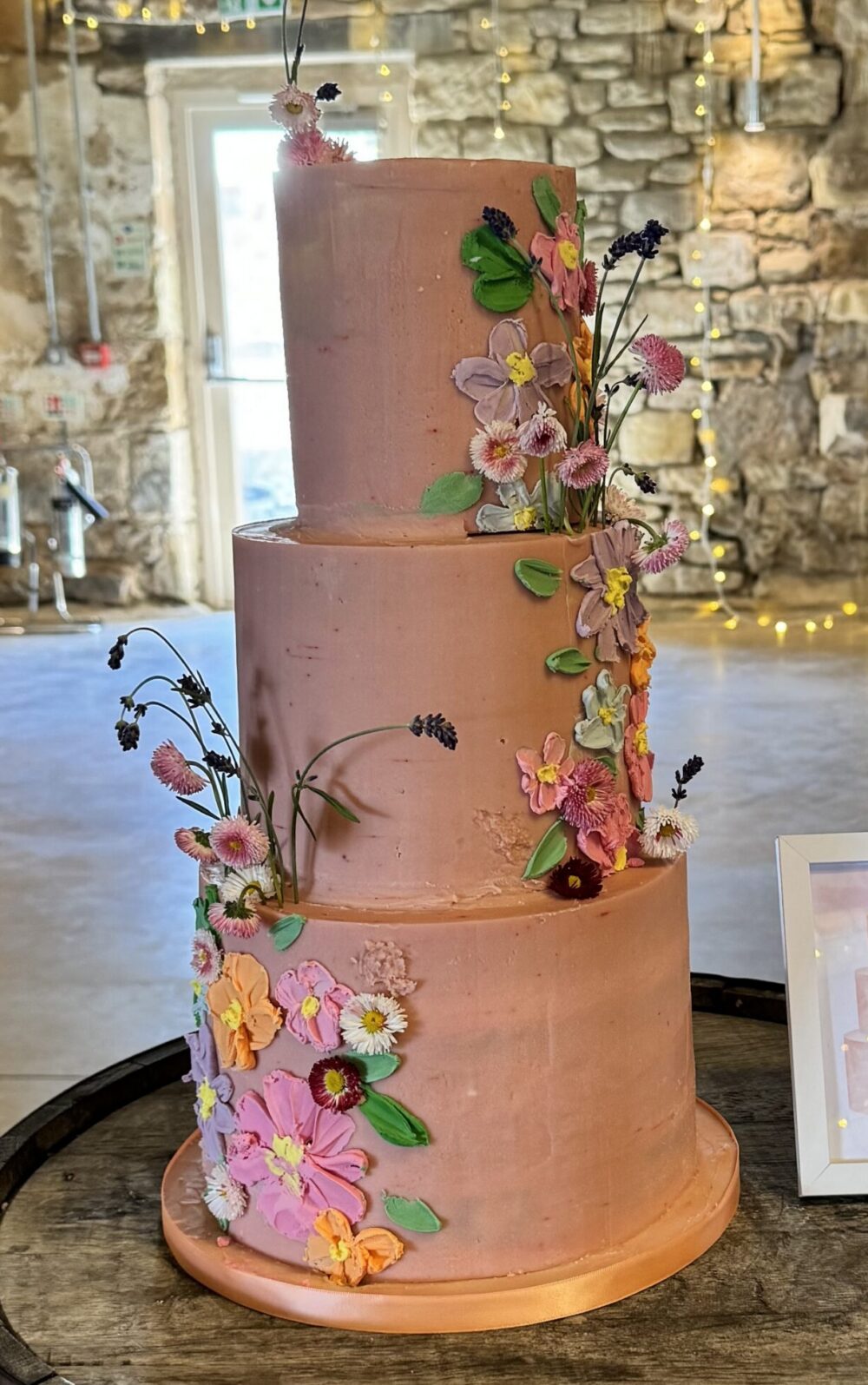
There are some fantastic specialist edible-flower growers in the UK, and using what’s naturally available can add something really special to a cake.
There is, however, a catch.
Seasonality.
Edible flowers don’t operate according to your Pinterest board.
If you want a particular fresh flower in January and it isn’t naturally available from my edible-flower supplier in January, I can’t simply nip to a florist and buy it instead.
We either embrace something beautiful that is in season…
Or I make it.
And that’s where things get really interesting.
Sugar flowers don’t care what month you’re getting married
Want roses in January?
Fine.
Want an orchid in a colour that orchid has absolutely no intention of producing naturally?
Also fine.
Want something enormous and sculptural? Tiny and delicate? Botanically realistic? Completely fantastical?
We can do that.
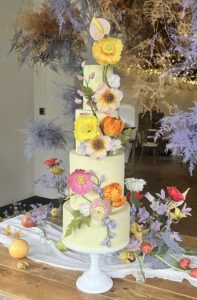
That’s why I don’t see sugar flowers simply as substitutes for fresh flowers. They’re an artistic medium in their own right.
I can control the colour, scale, shape and composition. I can recreate flowers from your wedding florals or take inspiration from them and create something that works specifically with the cake design.
And unlike fresh flowers, they don’t have to disappear after the wedding.
I’ve had couples buy acrylic display cases specifically so they can keep their sugar flowers afterwards.
They can last for years when stored correctly, although sugar flowers and Scottish humidity occasionally have a complicated relationship. That’s another blog entirely.
And no, I don’t have a problem with florists
Quite the opposite.
I adore floristry.
I follow florists because I genuinely love what they create, and some of the sculptural floral work being produced around the world is incredible.
But a florist’s expertise is floristry.
Mine includes working with food.
A florist isn’t necessarily trained in food safety or expected to know whether every flower and foliage variety they use is suitable for consumption. Why would they be? They’re creating floral designs, not ingredients.
The best results come when our two worlds communicate.
If I need to know which flowers or colours your florist is using, I’ll ask. I can then source suitable edible flowers or recreate elements in sugar so the cake and floristry feel like they belong in the same room.
Nobody needs to push the bridal bouquet into the buttercream to make them match.
Flowers belong on wedding cakes. Just make sure they’re the right ones.
I don’t want couples to read this and become frightened of having fresh flowers on their wedding cake.
Quite the opposite.
Please have flowers on your cake.
Have delicate seasonal edible flowers.
Have an explosion of sugar flowers.
Have one enormous sculptural bloom.
Have something completely fantastical that doesn’t exist anywhere outside my slightly overactive imagination.
Flowers can completely transform a wedding cake.
I simply don’t believe something being beautiful is enough reason to put it onto food.
Not every flower is edible.
Not every flower was grown with food contact in mind.
And wrapping a stem doesn’t change either of those things.
When there are safe alternatives that give us virtually limitless creative possibilities, I can’t see a good reason to take the risk.
If we’re putting fresh flowers on your wedding cake, let’s make sure they belong there.